Showing posts with label 2000. Show all posts

Tuesday, June 29, 2010

The Gleaners and I

screen-capture-21

So, as excited as I was to see Metropolis... it ended up slipping my mind completely. I came home from work absolutely starving, and at the prospect of going out for Mexican food, I forgot anything else. I felt very stupid when I realized what I had done, but I don't entirely regret it.

Sad as I was to miss that, I did pick up this Agnes Varda documentary, which I described to everyone around me as "a French documentary about gleaning," revealing that it is no mystery how I end up watching my movies alone on the couch with a mug of coffee. This is a poor description of what this film is, but I guess I didn't bother to elevate its charms much, since I knew I would end up watching it alone, regardless.

Sunday, October 11, 2009

Quills


I owe a lot to this movie. I think it is partially responsible for shaping my taste, and helping me to realize my devotion to more deranged cinema. At the very least, it helped me realize my love of cinema that is not merely escapism, and is, in fact, too gut-wrenching and disturbing to ever be considered as such. I'm not sure I could say what made me adore this movie so much when I first saw it, which was just a little after it came out in 2000 (this would put me at about age 12 or 13). Partly, it could be the way it moves so seamlessly from the satirical into the disturbing--so smoothly that you aren't sure what happened. Now, I have seen the film so many times that it is almost more difficult to pick it apart, as I do whenever I watch a film now. Quills made a big critical splash at the time and is part of Philip Kaufman's rather impressive oeuvre, alongside his remake of Invasion of the Body Snatchers and The Unbearable Lightness of Being.


Quills
is essentially a parable about self-expression, both artistic and sexual. And every film about art usually has a confluence of the two (is art possible without sex? Is sex possible without art? Is art sex? Is sex art? Would my parents have allowed me to rent this if they actually knew what it was about?) Nearly every exchange in the movie is sexualized in some aspect; every conversation is a power-play. This is, after all, a film about the origins of sado-masochism. Madeleine (Kate Winslet, who always rules) is a laundry-maid in a mad-house, caught between two men who are completely polarized in their attributes. The Marquis de Sade (Geoffrey Rush, who usually rules) is as full of perversions as the stories he is illegally publishing from within his mad-house prison. The Abbe (Joaquin Phoenix, who is okay when he is not Johnny Cash) is pious, virtuous, and gentle, and practically effeminate as a result. He oversees the asylum residents, attempting to use varying sorts of humane therapy (painting, theatre, choir) to keep them in check. The characters abide in a subtle balance until the entrance of Dr. Royer-Collard (Michael Caine) whose reactionary methods unleash a tidal wave of suck.

Sort of reminiscent of this seminal image, no?


Long story short: Abbe's repressed sexuality eventually drives him insane, putting him into the same cell that the Marquis had previously occupied. Despite the myriad disgusting fantasies pulsing through his mind, the Marquis is, seemingly, more aroused by the process of putting them to paper. His most poignant sexual act is writing, just as Madeleine's is reading. Both sex and art are complementary functions of human individuality. Neither can be repressed without egregious results like insanity or death, at least, if you happen to live in an insane asylum in Revolutionary Era France.


Naturally, there is a lot of voyeurism as well, which brings to mind the scopophilia of cinema in general. According to Freud, scopophilia is already an erotic tendency, a fundamental part of human sexuality. Particularly when a large part of the subject matter of the film is already related to sexuality, the look becomes even more eroticized. Whether or not Kaufman is intentionally bringing this out, it remains in the subtext. There are many close-ups on key-holes and watching through holes in the wall. In one particular scene, Abbe and Royer-Collard watch the Marquis through a rectangular window in his door, while he carries on as if he is an actor caught in the middle of a screen-performance. Coincidentally, he is rehearsing the theatre group. We, as an audience, witness the many sexual scenes, unfolding in a hermetic world that is unknowing of our presence. We are made voyeurs over and over.


Upon being confronted about leaking the de Sade's manuscripts to the publisher, Madeleine describes how she placed herself in the stories, allowing herself to play out her fantasies. This moment is descriptive of human interaction with any narrative art-form, cinema included. To put oneself into a narrative is almost a sexual act in itself, as reader and writer intermingle to create something new--an experience that is unique to the reader (or viewer). Certainly, being able to enter this world for a few hours is transportative, exactly the way cinema should be.

Tuesday, September 8, 2009

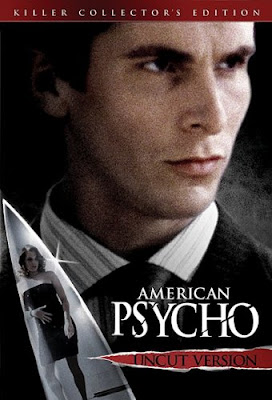
American Psycho


In accordance with my promise to make women directors a prominent feature of this blog, I recently watched American Psycho, which is a Marry Harron film. Actually, it was more of a fortuitous accident, since my family felt like communing to watch some kind of horror movie. The Blockbuster selection was epically weak, but they did have this one. And I thought, aha!

For the most part, I really dig this movie. It's an excellent adaptation of the Bret Easton Ellis book. Harron's film is equal parts satire and moody horror. For the most part, she manages to negotiate between fear and humor (though more fear and less humor would have been appreciated on my part, but that's just personal taste). Both the film and the novel are an overt criticism of the Reagan era. It appears that the deranged psycho-path, Patrick Bateman (Christian Bale) is forged in the primordial ooze of inescapable superficiality and dog eat dog economics that characterized mega-rich society in Reagan's America. With his immaculate exterior and rotten core, Bateman is the embodiment of the Regan 80s. Working an ambiguous job on Wall Street, Bateman spends his free time either fantasizing about or commiting brutal and disgusting crimes. It is the American dream gone haywire. When you were born at the top, I guess the only place to go is down, and to take as many people as you can with you. Interestingly, Bateman does not have a preference for victims. He takes the lowest of the low (a homeless man, a hooker) along with the most successful, without discretion.

One can never quite tell whether Bateman actually performs the gratutious acts depicted, or if they are elaborate, consuming fantasies. If they are real, they are readily ignored in the solipsistic city-dwellers. Not only are the characters self-absorbed, but they are practically interchangeable, reduced to virtual clones by marketing schemes, the drive to have the best. Actually, they are literally interchangeable--so alike that men are constantly mistaken for one another. It is never apparent whether Bateman gets away with murder because the people around him are truly apathetic, or if his fantasy world has overtaken his reality. This is just one more way Harron creates a duality throughout the film. She also has a way of portraying unease through the extravagances of the rich, showing the rawness lurking behind the perfect facade. The intense close up of syrup on a gourmet plate is blood spatter, and the face mask Bateman removes makes him look like a slasher villain a la Michael Myers.

Visually, this film is practically noirish. In the office buildings, we often see the shadows of venetian blinds cast across the scenes. In a way, its not hard to draw comparisons to noir, here. A private detective even shows up, yet there is too much conflicting evidence to pin down whether a crime has been committed or not. Shot mostly at night, the city is very Gotham-esque, overbearing, angular and grim; it is a city where evil abides, yet there is no superhero to counteract this menace. The outdoor scenes starkly contrast the interior scenes, particularly those in Bateman's apartment, where there is nothing but clean, uncluttered, modern lines.

The film would have benefited from a larger part for Bateman's secretary, Jean (Chloe Sevigny), who offers a more empathetic perspective. She is bumbling and pathetically naive. As a result, during her too-short screen time, I found myself praying for her deliverance. It's an interesting film, although it sort of peters out at the end. It is left ambiguous whether Bateman has imagined it all. As a result, nothing changes. There is no digging to find a message, either. At times the satire is just a bit too over the top, like the moment where Bateman is dragging a body through his building and an acquaintance inquires about the make of the bag. It's an imperfect film, but still a very interesting one.