Showing posts with label psychological thriller. Show all posts

Thursday, September 8, 2011

La Ceremonie

It's my great misfortune to have discovered Claude Chabrol's films just after he passed away. This means that, once again, I find myself smitten with a ghost. Chabrol is known as the French Hitchcock, and that's pretty apt, really. Much like Hitchcock, Chabrol uses thrillers as a psychological vessel, but with a characteristic that is definitively French. His movies are about feeling more than action, situation more than plot. Hitchcock had the Macguffin; Chabrol needs no excuse to engage in his scenarios of tension. I can't really claim to know much about Chabrol's filmography; I've only just begin. Likewise, I'm no master on Hitchcock, just a would-be diver dipping my toes in the pool. So, I should stick to those films I do know, one of which is Chabrol's 1995 film, La Ceremonie, a truly haunting portrait of class division and resentment. In La Ceremonie, the relationship of a family and their maid slowly becomes toxic, leading to a finale of sudden and irrevocable violence. This film is less of a thriller than a mystery. There is no central puzzle to unravel; the mystery lies in the hearts of the characters themselves.


Thursday, February 25, 2010

Don't Look Now


This is a psychological and moody thriller with a jarring and unpredictable end to it. Well, it's not unpredictable, at all, actually. But it's still incredibly shocking, which is quite a feat, if you think about it. But then, this isn't a film for lovers of narrative. It has sort of an interesting narrative formula--it begins and ends with a bang, with a lot of floating in between of prescient imagery and dialogue, as well as a famed sex scene.

I actually watched this on Valentine's day, solidifying my penchant for the macabre on holidays with expectations of familial and/or romantic affection. However, this movie was totally appropriate. First of all, check out the visual theme of blood red! Secondly, the story is centered on the loving, albeit strained relationship of a married couple, John and Laura Baxter (Donald Sutherland and Julie Christie), following the death of their young daughter. This event takes place in the opening scene of the film. John has a sudden vision of the occurrence shortly following the ominous spill on the slide he is working with (see above). Throughout the rest of the film, we are revisited by images that recall the dead girl in his arms.

Following this calamitous event, the Baxters relocate to Venice, where John is restoring a church. Being constantly surrounded by water, much like the lake where their daughter met her demise, this is the perfect setting for the inevitable portentous reflection and imagery. Roeg also uses the setting to evoke a sense of isolation and even claustrophobia.

What really makes this film visually memorable is not only the many reflective shots and zooms, but the harshness of the parallel editing. Although it is often used to represent simultaneity of actions across a distance, the editing here sometimes has the effect of creating an overlay of present and future. The opening scene lays the groundwork for this editing style. As John and Laura lounge about in their living room, their daughter runs by the waterside. Though the daughter is an important character in the film, we never see her alive with either of her parents; she is, and will always be, separate. Probably the most famous montage in the film is the lengthy, graphic sex scene, which is inter-cut with images of the Baxters getting dressed afterward, in their separate spaces. I think this collapsing of time is interesting, since this is a movie where fate plays a big role. Time is out of sync, as if it doesn't matter. Of course these montages also highlight the separateness of the characters. Simultaneously, they are having incredibly separate experiences, each one alone.

I am a sucker for supernatural elements in fiction and film, particularly if they are used well. In Don't Look Now, Laura stumbles upon a pair of sisters, one of whom has the gift of "seeing". She is blind, but she can interact with the dead. There are hints that John has this capability as well, though he is suppressing it. This undercurrent of clairvoyance creates an interesting circularity in the plot. The film begins and ends with deaths that are inexorably linked. By the end, I wondered whether the imagery throughout the film was recalling John's daughter's death or (ahem, SPOILERS) predicting his own. In its final moments, this movie gets extremely dark, and as I said, shocking.

Also, if you're interested, I found this funny montage of the film, which is set to a Moby song. The internet makes great things, doesn't it?

And because I just can't help myself... the final moments of the film, which means, the part when all is revealed. And also a good demonstration of the montage technique used throughout to heighten the fatalistic aspects. I hate the term SPOILERS, since this blog isn't really about reviewing; it's about analysis (however basic). But I guess it's only polite to use it here.


Sunday, October 11, 2009

Quills


I owe a lot to this movie. I think it is partially responsible for shaping my taste, and helping me to realize my devotion to more deranged cinema. At the very least, it helped me realize my love of cinema that is not merely escapism, and is, in fact, too gut-wrenching and disturbing to ever be considered as such. I'm not sure I could say what made me adore this movie so much when I first saw it, which was just a little after it came out in 2000 (this would put me at about age 12 or 13). Partly, it could be the way it moves so seamlessly from the satirical into the disturbing--so smoothly that you aren't sure what happened. Now, I have seen the film so many times that it is almost more difficult to pick it apart, as I do whenever I watch a film now. Quills made a big critical splash at the time and is part of Philip Kaufman's rather impressive oeuvre, alongside his remake of Invasion of the Body Snatchers and The Unbearable Lightness of Being.


Quills
is essentially a parable about self-expression, both artistic and sexual. And every film about art usually has a confluence of the two (is art possible without sex? Is sex possible without art? Is art sex? Is sex art? Would my parents have allowed me to rent this if they actually knew what it was about?) Nearly every exchange in the movie is sexualized in some aspect; every conversation is a power-play. This is, after all, a film about the origins of sado-masochism. Madeleine (Kate Winslet, who always rules) is a laundry-maid in a mad-house, caught between two men who are completely polarized in their attributes. The Marquis de Sade (Geoffrey Rush, who usually rules) is as full of perversions as the stories he is illegally publishing from within his mad-house prison. The Abbe (Joaquin Phoenix, who is okay when he is not Johnny Cash) is pious, virtuous, and gentle, and practically effeminate as a result. He oversees the asylum residents, attempting to use varying sorts of humane therapy (painting, theatre, choir) to keep them in check. The characters abide in a subtle balance until the entrance of Dr. Royer-Collard (Michael Caine) whose reactionary methods unleash a tidal wave of suck.

Sort of reminiscent of this seminal image, no?


Long story short: Abbe's repressed sexuality eventually drives him insane, putting him into the same cell that the Marquis had previously occupied. Despite the myriad disgusting fantasies pulsing through his mind, the Marquis is, seemingly, more aroused by the process of putting them to paper. His most poignant sexual act is writing, just as Madeleine's is reading. Both sex and art are complementary functions of human individuality. Neither can be repressed without egregious results like insanity or death, at least, if you happen to live in an insane asylum in Revolutionary Era France.


Naturally, there is a lot of voyeurism as well, which brings to mind the scopophilia of cinema in general. According to Freud, scopophilia is already an erotic tendency, a fundamental part of human sexuality. Particularly when a large part of the subject matter of the film is already related to sexuality, the look becomes even more eroticized. Whether or not Kaufman is intentionally bringing this out, it remains in the subtext. There are many close-ups on key-holes and watching through holes in the wall. In one particular scene, Abbe and Royer-Collard watch the Marquis through a rectangular window in his door, while he carries on as if he is an actor caught in the middle of a screen-performance. Coincidentally, he is rehearsing the theatre group. We, as an audience, witness the many sexual scenes, unfolding in a hermetic world that is unknowing of our presence. We are made voyeurs over and over.


Upon being confronted about leaking the de Sade's manuscripts to the publisher, Madeleine describes how she placed herself in the stories, allowing herself to play out her fantasies. This moment is descriptive of human interaction with any narrative art-form, cinema included. To put oneself into a narrative is almost a sexual act in itself, as reader and writer intermingle to create something new--an experience that is unique to the reader (or viewer). Certainly, being able to enter this world for a few hours is transportative, exactly the way cinema should be.

Thursday, September 10, 2009

Dead Ringers


Being a twin myself, I think I'm in a position to adequately judge this movie, as far as the portrayal of twinning goes. Unfortunately, portrayals of twins in literature and film rarely have anything to do with accurate representation of what being a twin is like... and honestly, it would be kind of boring if that was the aim. This, er, condition, if you want to call it that, offers an incomparable stage for authors to play out their complexes.

In Cronenberg's film, Jeremy Irons turns in a brilliant performance as both Beverly and Elliot Mantle. Not only does he act out a good half of the film against himself, but he creates two very different characters without taking the easy way out and polarizing them entirely. Both are very real and unique, while also being subtly similar, as real twins might be. Irons' performance is just one thing that makes this film great. The rest has to do with the atmospherics that Cronenberg always brings to his films, as well as psychological turmoil, and good ol' Howard Shore tagging along to create mood music.

The brothers, although obvious individuals (one course, one more gentle), live life almost as if they were a unit. They share a profession (incidentally, at a fertility clinic), an apartment, and the sleep with the same women. When Claire (Genevieve Bujold) steps into the office, Beverly and Elliot prey on her immediately. It is this misstep that sends a unfathomable chain of events rocketing into motion. Claire is no ordinary woman. She is an actress. She wants a baby... She has three sets of ovaries. Unlike most people, she is perceptive enough to figure out on her own that she is sleeping with two different men.

This film is an exploration of the surface and the metaphysical that lies behind it. The Mantle brothers are preoccupied with inner beauty in the way most people are preoccupied with outer beauty. But their version of inner beauty is equally superficial. They are fascinated by internal organs. It is perhaps even more unsettling that the human obsession with outer beauty. In film and subsequently, often in reality, the appearance of a person is perceived to be symbolic of the kind of person they are. When it comes to admiring the beauty of internal organs, what exactly is the denotation? Presumably, all organs are nearly exactly the same. Interestingly, the internal organs the brothers have primary contact with are the female sexual and reproduction organs--the origins of life. Beverly and Elliot cannot seem to fathom their own uniqueness, as they are physically identical. Claire, on the other hand, has, out of necessity split her outer self from her metaphysical self; she is an actress. Her constantly changing facade represents nothing of what she actually is.


One of my favorite scenes was especially representative of this. Claire is in the make up room. We see her in profile as Elliot comes to visit her, to rectify what he and Beverly have done and to get her back. He insinuates that most women are more than happy to overlook the difference between them, and to take them both. Claire refuses him. During their conversation, the camera jumps from the initial profile to her opposite cheek, on which a bruise has been colorfully applied with make up. "Are we really that different?" he asks. "Yes," she replies, "you really are."

It is interesting that this is the woman they both initially fall for: imperfect by their standards of "inner beauty", and also incapable of conceiving.
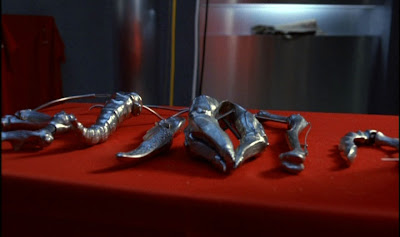
Later, we get into more Cronenbergian territory when Beverly has special tools made up for dealing with "mutant women." As he becomes more tortured (as his relationship with his brother becomes more tortured), he becomes frightened by the women he sees, claiming that their bodies are "all wrong." His tools look like Medieval torture instruments, with no discernible purpose. In the operating room, Elliot is suited for surgery in a red, full-bodied gown that looks like something out of A Handmaid's Tail. Framed in the window with arms outstretched, he is some kind of twisted Prometheus. With the power he holds over human conception, he is, perhaps the closest thing to a God on earth.

This was my first time viewing this film, and though it failed to answer any questions for me, the meditation it inspired was fantastic. Sometime soon I'm going to give it another try, but not before it must go back to the library, from whence it came.