Showing posts with label Criterion. Show all posts

Friday, August 20, 2010

Eyes Without a Face

slump


screen-capture-2

So here I am in Chicago, Illin'-ois. I began this blog about exactly a year ago when I was in a similar state of aimlessness (er, joblessness), so although I'm currently on the hunt for another dead end job, I'm looking forward to some empty hours that I can use getting lost in the cinema.

I discovered this title, as I am wont to do, by performing a Google search for "50s sci-fi" or the like. What I was really looking for was some good old American camp, but I ended up finding this haunting piece of French film instead. It's from 1959, but according to my Criterion insert, Franju operated on a parallel trajectory from the New-wavers. Still, to me, it seems like the ground-breaking nature of this film might put him in a similar arena. Like Godard, Georges Franju had an affinity for American films. He just happened to like our gory B horror films, instead of Humphrey Bogart noir pictures.

Wednesday, April 21, 2010

Picnic at Hanging Rock


In the year 1900 in Australia, a group of girls from Appleyard College, which seems to be little more than a bourgeoisie finishing school, go on a picnic to Hanging Rock, a beautiful, and craggy geological formation on the edge of the bush. Several students and one of their teachers vanish without a trace. This story is rumored to be based on truth, but as far as I can tell, it is entirely fictional.

In the novel upon which Picnic at Hanging Rock is based, the author actually included an explanation of what happened to the girls who disappeared. When it was published, this piece was left out because the story is so much stronger without it. One of the prettiest of the differences between fiction and real life is that in the fictional realm, no explanation is necessary. Real life doesn't offer that kind of poetic power. If the girls had disappeared in real life, there would be an answer somewhere, and during sweeps season, the hard-working scientists on CSI would find it. In Peter Weir's adaptation of Picnic, there is no causal explanation, no physical evidence, only speculation that the girls did not belong in the world they found themselves in, and thus, ceased to exist.

Saturday, March 6, 2010

Les Diaboliques

screen-capture

If this movie seems somewhat dated now, it's only because it set the precedent for movies of its kind. It is a well-known influence on Psycho, for instance. I think it probably operates in a different way now than when it was first released. Any modern viewer who is even partially literate in the thriller genre will have a pretty good idea of how it might turn out. In that case, the thrills lie in the movement from point A to the inevitable point B. And you can revel in the filmmaking that takes you there. In Les Diabolique, Michel Delassalle's (Paul Meurisse) wife, Christina (Vera Clouzot) and mistress, Nicole (Simone Signoret) conspire to kill him. This plan is already in place at the outset of the film; his murder takes place in the first 45 minutes or so. From the on, the narrative is driven by Christina's contrition, fear and consequential hysteria.

screen-capture-1

screen-capture-2

The scene above foreshadows the coming events, and demonstrates the power relationships pretty nicely. In contrast to Michel and Nicole, Christina is brittle and weak, with a heart condition to accompany her emotional fragility. Her already diminutive appearance is accentuated by the school girl braids that adorn her head throughout the film. She is dominated by all the characters around her, including Nicole, who pushes her to carry through with their homicidal plans.

screen-capture-3

screen-capture-4

screen-capture-6

Close ups! Reaction shots!

screen-capture-8

screen-capture-9

screen-capture-11

Due to the nature of Michel's death, there is an understandable focus on liquids. The opening credits take place over an abstract sort of background that is later revealed to be the swimming pool in the school yard. Bathtubs and pools are filled and emptied, as are pharmaceutically altered wine bottles, like the one that leads to Michel's immobilization. At one point, Plantiveau (Jean Brochard), the caretaker compares a full bottle to the soul, which, as we reflect on the doctored wine from a few scenes earlier, adds a new level to Christina's religious guilt about her actions. I also like to think there's some Stygian metaphor here, particularly in the many images of the murky pool water. The image above is very reaper-esque to me. There is also a sense of fatalism as Christina waits for the caretaker to discover the body once he has drained the pool. Meanwhile, the boys behind her are reciting their language lesson, conjugating the verb "to find."

screen-capture-13

screen-capture-14

screen-capture-15

screen-capture-16

The best part of the film is the denouement, of course. Where the film, which has been relatively fast paced up until this point, slows down dramatically. The sense of space becomes drastically different, as well. The hallways that the frightened Christina stumbles through seem endless and labyrinthine. The way the sequence is edited, it is nearly impossible to ascertain where Christine is in the house and whether she is the one following or the one being followed.

screen-capture-17

screen-capture-18

(Spoilers) Another thing I like about this ending is the way in which it recalls an earlier moment in the film where Christina notes that she her only wish is that Michel would be aware that she had killed him. In a similar fashion, Christina will never know exactly how her own death came about. She is positive that she has committed murder, and that she is a murderer. Therefore, it is true. It doesn't matter that Michel was never actually dead. She still intended to kill him, and took all the necessary steps to ensure that it happened. In the end, they are all sinners; they are all devils.

Monday, February 15, 2010

L'avventura

Form is content in Antonioni's L'avventura, which makes it a slow watch in this, the age of hyper-editing. But if you are willing to slow down for a moment, maybe boil water for tea, percolate the coffee, and take a deep breath; the slowest film is always worth the wait. That being said, I can't add much to the girth of criticism on this film, but I can add my own meager observations.

The plot is minimal. A group of friends embarks on a cruise. Anna (Lea Massari) is engaged to Sandro (Gabriele Ferzetti), but she has gotten used to the distance between them; she has become accustomed to being alone. When they land on an island to explore, Anna disappears without a trace. It is almost as if she never existed at all. And the existence of the other characters is equally nebulous.

Sandro and Claudia (Monica Vitti), Anna's best friend, spend the rest of the film hopelessly in pursuit of her. By the end, their journey is devoid of purpose, as they realize that they do not wish to find her anymore. Claudia says:
Just several days ago, the thought of Anna being dead would have made me sick.
And now, I don't even cry, I'm afraid she might be alive.
Sandro and Claudia have fallen in love, but their love is just as empty as the one previously shared by Sandro and Anna.

It is pretty well acknowledged that this film is a criticism of the idle upper class, a group of people who care so little about anything that they spend the entirety of the film wandering around, becoming engulfed by their surroundings and ricocheting off of each other without true connection. They are incapable of true connection. In one scene, Claudia and Sandro are on top of a church, playing with the ropes that set the bells ringing. When they begin to ring loudly, the lovers hear more ringing off in the distance, seeming to answer them. It is more likely though, that what they are hearing is simply an echo, and not a real communication at all.


Before this, the only Antonioni I had seen was Blow-Up, which I have now seen several times. What actually made me finally track down L'avventura was reading Vinyl is Heavy, and their obsession over there with Monica Vitti. Any obsession with this woman is well-founded. You can't take your eyes off of her, and considering that half of what she does in this film is wander aimlessly through streets and scenery, this is a pretty spectacular feat. Her graceful body language and her heavy-lidded eyes own the camera's gaze. Partly, this is Antonioni's doing, and this is one thing that makes me suspect that there is more going on here than bourgeoisie ennui. Over and over Claudia becomes objectified by the male gaze, as do many of the other women. In particular, Claudia is consistently trapped by the framing, making her seem caged.


The gaze is prominent here, in a scene showing Giulia's (Dominique Blancher) puerile romp with a young painter who depicts only the female body in his art.

The above scene is interesting, because it is one of the several examples in this film of the revelation of an "establishing shot" following the entrance to the scene, rather than at the beginning. Here you see Claudia leaning against a stone wall, then the camera provides a wider shot, showing her as the center of a captive male audience. Perhaps we are being implicated in this gaze as well. Maybe Claudia, like Anna, exists solely as an object of the gaze. Anna disappears when she decides that she does not want this gaze to define her. Much later, Claudia despairs when she fears she has lost Sandro's attention. The woman are surfaces, and not much more. They are figments struggling against their tenuous relationship to reality.


When the film ends, one senses that it is beginning all over again.

Sunday, February 7, 2010

Sonic Youth Picks Criterion Films


One of the things I love about surfing around Criterion is that they have a list of top ten films from such illustrious folks as Jonathan Lethem, Diablo Cody, and Steve Buschemi. Now they have a listing for Sonic Youth, as well!

Go an' see!

I always find it interesting to see what various artists cite amongst their favorites, especially people who aren't directly associated with the biz, like Lethem and Sonic Youth. I would be especially interested in other authors who are obviously heavily influenced by film, like Don DeLillo. With all of the references in his songs, I'm sure Kevin Barnes of Of Montreal would come up with a good one as well.

Wednesday, January 27, 2010

Amarcord

The title means "I remember," and the film is based on Fellini's childhood during the fascist period. Roger Ebert likes to note that the people in his films always seem to be dancing to an unheard melody. This may be attributed to the music Fellini played on set, since the dialogue is dubbed in later. This also creates an effect that I love, a dreamlike environment where the action is separate from voice. Regardless of the cause, his films are a beautiful thing to watch. Here, he mainly keeps the camera at a safe distance from his subjects, thereby preventing the humorous from becoming overwrought. The film is unofficially demarcated by seasons, which create the pacing for a year in Titta's life--his coming of age.

As with 8 1/2, there is even a demented prostitute lurking on the beach.


And a bleak-looking scaffold, never finished.

The religious aura of a cinema.


In one scene, the entire town turns out to see an ocean liner pass by in the night. One of the men shouts that it is one of the most glorious things that the fascist regime has built. Directly following this scene, the town is plunged into an impenetrable fog, an image which seems to speak even louder than Titta's anarchist father about the evils of fascism.

Before the fog lifts, we bear witness to the young men dancing in the fog with imaginary women. So much of this film is devoted to the dreams of young men. Women are idolized; they are the dream. The glory of fascism is also a dream.


Fellini is one of my favorite filmmakers. His films always evoke a pure joy of watching that is separate from narrative. I don't watch them because I care about the narrative arc; I just can't tear my eyes away. This film is an impeccably choreographed dance to Nina Rota's beautiful score. It is the perfect reworking of a distant memory, idealized and dreamy.

Friday, January 8, 2010

Peeping Tom

My experience of Peeping Tom was rather cobbled together. First, I waited for the DVD from the library for so long, I forgot that I had ordered it. Then, when it finally arrived, the DVD was so damaged, I couldn't even watch it all the way through. (It stalled, quite suspiciously, right before the one nude scene in the film.) However, I managed to finish it by streaming in on IMDB.com with limited commercial interruption! With much travail, I saw something approximating the entire thing. I didn't dare to screen-cap it, though. So I'm making do with borrowed images.

On the Criterion DVD there is a featurette entitled "A Very British Psycho," which is quite apt, at least in its reference to Hitchcock. Actually, Peeping Tom reminded me just as much of Rear Window, with the camera's obvious parallel to the phallus (in PT, there is a lot of sensual caressing of the lens), as well as the self-reflexivity. Technically, Jeff of Rear Window is much more of a peeping tom than Mark Lewis (Carl Boehm). Like Rear Window, the film calls attention to the audiences' own voyeurism. Like Psycho, the film revolves around a serial killer whose homicidal tendencies derive from deep psychological trauma. In the case of Mark, this is a result of having been the guinea pig in his father's experiments.

Because of the camera's constant presence in the frame, it is practically another character in the film. It is a sexual object, too; but more than anything, it is a weapon. When we see what Mark is filming, we see his subjects in the cross hairs of the viewfinder, as if he is training a rifle on them. Of course, the camera is also the primary instrument in his murders. Through his murders, Mark attempts to capture the perfect expression of terror. As it turns out, he does this by training a mirror on them, forcing them to watch their own deaths. Mark inverts his own "morbid urge to gaze" by forcing his victims to watch themselves.

This is all the more disturbing, as the camera is, as his lover, Helen (Anna Massey) suggests, an extra limb. Guess which one? The penetration of sharp spear that provides the quietus suggests another kind of penetration.

While there are a lot of interesting philosophical facets in this film, I simply found it a joy to watch, much like Black Narcissus. Black Narcissus is a better film, I think, but the playfulness of certain scenes is reminiscent to its predecessor. The budding relationship between Mark and Helen is heart-wrenching, as is the scene where the hopeful actress, Vivian (Moira Shearer) does a lengthy warm up dance number, not knowing that it will be her last.

As it turns out, Helen's mother is blind. The overtness of this narrative ploy is one that I could live without, in some ways. Naturally, this handicap has provided her with other heightened forms of perception. When Mark comes home to find her lurking in the darkness, she remarks that the blind live in the rooms they live under. From the softness of his footsteps, she infers that he is troubled. For some reason, Mark turns his camera on her, and to no one's surprise, it doesn't work, because she cannot see herself. Still, she is terrified of being filmed, perhaps because she cannot return the gaze.


Images are from the awesomely prolific Criterion Contraption, which is also linked on the sidebar. Also, Images Journal.

Wednesday, November 18, 2009

Black Narcissus

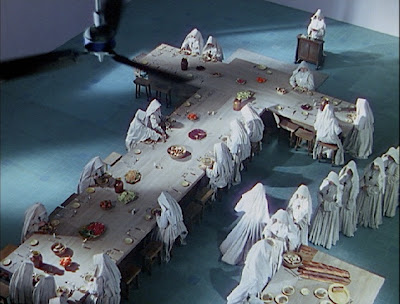
In Black Narcissus, a group of nuns, headed by Sister Clodagh (Deborah Kerr) are sent to the Himalayas to start a school. As Criterion states it, the film is a "fascinating study of the age-old conflict between the spirit and the flesh," which is, naturally, simplifying things a bit. It is true, though, that the premise encourages the audience to think directly along those lines as the hard-edged spiritual nuns are thrown headlong into a den of hedonistic sin, led by Mr. Dean (David Farrar). The new environment incites a deeply personal struggle for each of them. Black Narcissus surprised me. I was expecting something more dark. It was, at parts, but more often, it was playful and dreamy. Although the whole set-up is pretty surreal, it really seems to touch on something inherently human, although it is hard to describe exactly how. Through its dream walk atmosphere, the film explores a constant battle within ourselves between what we want ourselves to be, and what we are.
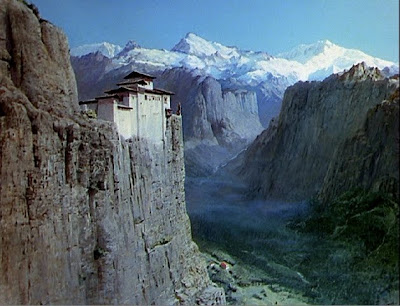
There's some imperialism thrown into the mix, as well, which i don't feel entirely equipped to deal with. In a manner that is reminiscent of the jungle in Heart of Darkness, it is the very atmosphere of the place that seems to drive the inhabitants to madness. For the most part, the treatment of the natives is similar, too. With several exceptions, they are presented en mass, always on the periphery. Simultaneously, they seem to be at the center of the narrative and outside of it.

In a stark building, perched on top of desolate mountains, surrounded by drumming natives, the nuns attempt to do their work. The imagery on top of the mountains suggests something between Eden and Mount Olympus, but it is made ominous by frequent, exaggerated high angles, which show the land below disappearing into fog. Often, the place seems to be outside of reality. It is totally isolated, and the wind is constantly blowing with a steady drone underneath the action, causing the nun's habits to be in constant motion. The Saris of the natives, particularly the sultry Kanchi (Jean Simmons) move in a similar way as if drawing a comparison between these polar opposites.
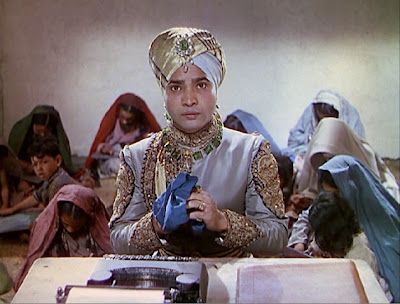
In one of my favorite scenes, Sister Clodagh confronts Sister Briony (Judith Furse) about her waning spirituality. Briony is troubled by the atmosphere; she can see too far. It causes her to forget why she is planting potatoes, and then to question why she is doing it at all. I especially like this reflection on the space of the place; it's like the environment reflects or causes a void to open within the characters. Later, Con (Shaun Noble) teaches the Indian children English by marching them around the gardens, chanting the words for the objects they see. The almost musical rhythm of various flower names inter-cut with Sister Clodagh, who, while listening discovers that Sister Briony has indeed abandoned her potato planting, and has diverged totally from the strict plot of vegetables she was assigned. She rejects true sustenance for a kind of soul-sustenance. The same disintegration occurs in all of the nuns, including Clodagh, herself, who becomes plagued by memories of her past.

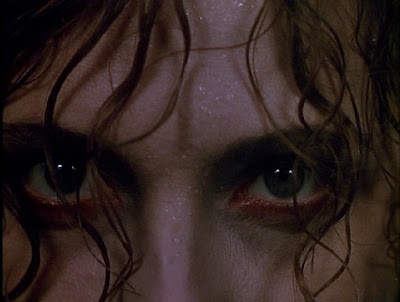
Most striking is the descent of Sister Ruth (Kathleen Byron) into psycho-sexual madness. This can only really be described in images:
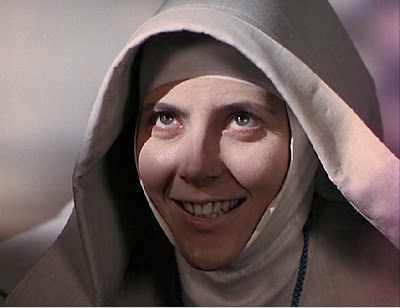
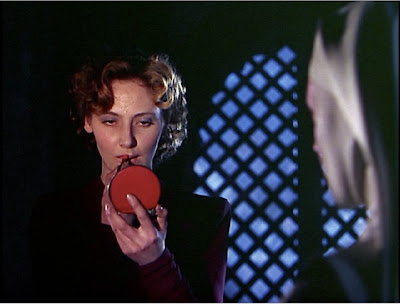
This is a haunting film, and I keep finding myself running certain scenes over and over in my mind. To say that this is just a parable about sexual repression would be far too reductive. Black Narcissus is the kind of film that is almost too good for this kind of analysis. It leaves you with something you can't explain; you have to just see it for yourself.