Showing posts with label thriller. Show all posts

Thursday, September 8, 2011

La Ceremonie

It's my great misfortune to have discovered Claude Chabrol's films just after he passed away. This means that, once again, I find myself smitten with a ghost. Chabrol is known as the French Hitchcock, and that's pretty apt, really. Much like Hitchcock, Chabrol uses thrillers as a psychological vessel, but with a characteristic that is definitively French. His movies are about feeling more than action, situation more than plot. Hitchcock had the Macguffin; Chabrol needs no excuse to engage in his scenarios of tension. I can't really claim to know much about Chabrol's filmography; I've only just begin. Likewise, I'm no master on Hitchcock, just a would-be diver dipping my toes in the pool. So, I should stick to those films I do know, one of which is Chabrol's 1995 film, La Ceremonie, a truly haunting portrait of class division and resentment. In La Ceremonie, the relationship of a family and their maid slowly becomes toxic, leading to a finale of sudden and irrevocable violence. This film is less of a thriller than a mystery. There is no central puzzle to unravel; the mystery lies in the hearts of the characters themselves.


Saturday, March 6, 2010

Les Diaboliques

screen-capture

If this movie seems somewhat dated now, it's only because it set the precedent for movies of its kind. It is a well-known influence on Psycho, for instance. I think it probably operates in a different way now than when it was first released. Any modern viewer who is even partially literate in the thriller genre will have a pretty good idea of how it might turn out. In that case, the thrills lie in the movement from point A to the inevitable point B. And you can revel in the filmmaking that takes you there. In Les Diabolique, Michel Delassalle's (Paul Meurisse) wife, Christina (Vera Clouzot) and mistress, Nicole (Simone Signoret) conspire to kill him. This plan is already in place at the outset of the film; his murder takes place in the first 45 minutes or so. From the on, the narrative is driven by Christina's contrition, fear and consequential hysteria.

screen-capture-1

screen-capture-2

The scene above foreshadows the coming events, and demonstrates the power relationships pretty nicely. In contrast to Michel and Nicole, Christina is brittle and weak, with a heart condition to accompany her emotional fragility. Her already diminutive appearance is accentuated by the school girl braids that adorn her head throughout the film. She is dominated by all the characters around her, including Nicole, who pushes her to carry through with their homicidal plans.

screen-capture-3

screen-capture-4

screen-capture-6

Close ups! Reaction shots!

screen-capture-8

screen-capture-9

screen-capture-11

Due to the nature of Michel's death, there is an understandable focus on liquids. The opening credits take place over an abstract sort of background that is later revealed to be the swimming pool in the school yard. Bathtubs and pools are filled and emptied, as are pharmaceutically altered wine bottles, like the one that leads to Michel's immobilization. At one point, Plantiveau (Jean Brochard), the caretaker compares a full bottle to the soul, which, as we reflect on the doctored wine from a few scenes earlier, adds a new level to Christina's religious guilt about her actions. I also like to think there's some Stygian metaphor here, particularly in the many images of the murky pool water. The image above is very reaper-esque to me. There is also a sense of fatalism as Christina waits for the caretaker to discover the body once he has drained the pool. Meanwhile, the boys behind her are reciting their language lesson, conjugating the verb "to find."

screen-capture-13

screen-capture-14

screen-capture-15

screen-capture-16

The best part of the film is the denouement, of course. Where the film, which has been relatively fast paced up until this point, slows down dramatically. The sense of space becomes drastically different, as well. The hallways that the frightened Christina stumbles through seem endless and labyrinthine. The way the sequence is edited, it is nearly impossible to ascertain where Christine is in the house and whether she is the one following or the one being followed.

screen-capture-17

screen-capture-18

(Spoilers) Another thing I like about this ending is the way in which it recalls an earlier moment in the film where Christina notes that she her only wish is that Michel would be aware that she had killed him. In a similar fashion, Christina will never know exactly how her own death came about. She is positive that she has committed murder, and that she is a murderer. Therefore, it is true. It doesn't matter that Michel was never actually dead. She still intended to kill him, and took all the necessary steps to ensure that it happened. In the end, they are all sinners; they are all devils.

Thursday, February 25, 2010

Don't Look Now


This is a psychological and moody thriller with a jarring and unpredictable end to it. Well, it's not unpredictable, at all, actually. But it's still incredibly shocking, which is quite a feat, if you think about it. But then, this isn't a film for lovers of narrative. It has sort of an interesting narrative formula--it begins and ends with a bang, with a lot of floating in between of prescient imagery and dialogue, as well as a famed sex scene.

I actually watched this on Valentine's day, solidifying my penchant for the macabre on holidays with expectations of familial and/or romantic affection. However, this movie was totally appropriate. First of all, check out the visual theme of blood red! Secondly, the story is centered on the loving, albeit strained relationship of a married couple, John and Laura Baxter (Donald Sutherland and Julie Christie), following the death of their young daughter. This event takes place in the opening scene of the film. John has a sudden vision of the occurrence shortly following the ominous spill on the slide he is working with (see above). Throughout the rest of the film, we are revisited by images that recall the dead girl in his arms.

Following this calamitous event, the Baxters relocate to Venice, where John is restoring a church. Being constantly surrounded by water, much like the lake where their daughter met her demise, this is the perfect setting for the inevitable portentous reflection and imagery. Roeg also uses the setting to evoke a sense of isolation and even claustrophobia.

What really makes this film visually memorable is not only the many reflective shots and zooms, but the harshness of the parallel editing. Although it is often used to represent simultaneity of actions across a distance, the editing here sometimes has the effect of creating an overlay of present and future. The opening scene lays the groundwork for this editing style. As John and Laura lounge about in their living room, their daughter runs by the waterside. Though the daughter is an important character in the film, we never see her alive with either of her parents; she is, and will always be, separate. Probably the most famous montage in the film is the lengthy, graphic sex scene, which is inter-cut with images of the Baxters getting dressed afterward, in their separate spaces. I think this collapsing of time is interesting, since this is a movie where fate plays a big role. Time is out of sync, as if it doesn't matter. Of course these montages also highlight the separateness of the characters. Simultaneously, they are having incredibly separate experiences, each one alone.

I am a sucker for supernatural elements in fiction and film, particularly if they are used well. In Don't Look Now, Laura stumbles upon a pair of sisters, one of whom has the gift of "seeing". She is blind, but she can interact with the dead. There are hints that John has this capability as well, though he is suppressing it. This undercurrent of clairvoyance creates an interesting circularity in the plot. The film begins and ends with deaths that are inexorably linked. By the end, I wondered whether the imagery throughout the film was recalling John's daughter's death or (ahem, SPOILERS) predicting his own. In its final moments, this movie gets extremely dark, and as I said, shocking.

Also, if you're interested, I found this funny montage of the film, which is set to a Moby song. The internet makes great things, doesn't it?

And because I just can't help myself... the final moments of the film, which means, the part when all is revealed. And also a good demonstration of the montage technique used throughout to heighten the fatalistic aspects. I hate the term SPOILERS, since this blog isn't really about reviewing; it's about analysis (however basic). But I guess it's only polite to use it here.


Tuesday, September 8, 2009

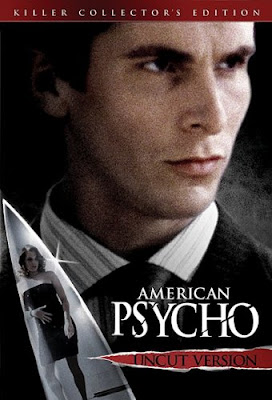
American Psycho


In accordance with my promise to make women directors a prominent feature of this blog, I recently watched American Psycho, which is a Marry Harron film. Actually, it was more of a fortuitous accident, since my family felt like communing to watch some kind of horror movie. The Blockbuster selection was epically weak, but they did have this one. And I thought, aha!

For the most part, I really dig this movie. It's an excellent adaptation of the Bret Easton Ellis book. Harron's film is equal parts satire and moody horror. For the most part, she manages to negotiate between fear and humor (though more fear and less humor would have been appreciated on my part, but that's just personal taste). Both the film and the novel are an overt criticism of the Reagan era. It appears that the deranged psycho-path, Patrick Bateman (Christian Bale) is forged in the primordial ooze of inescapable superficiality and dog eat dog economics that characterized mega-rich society in Reagan's America. With his immaculate exterior and rotten core, Bateman is the embodiment of the Regan 80s. Working an ambiguous job on Wall Street, Bateman spends his free time either fantasizing about or commiting brutal and disgusting crimes. It is the American dream gone haywire. When you were born at the top, I guess the only place to go is down, and to take as many people as you can with you. Interestingly, Bateman does not have a preference for victims. He takes the lowest of the low (a homeless man, a hooker) along with the most successful, without discretion.

One can never quite tell whether Bateman actually performs the gratutious acts depicted, or if they are elaborate, consuming fantasies. If they are real, they are readily ignored in the solipsistic city-dwellers. Not only are the characters self-absorbed, but they are practically interchangeable, reduced to virtual clones by marketing schemes, the drive to have the best. Actually, they are literally interchangeable--so alike that men are constantly mistaken for one another. It is never apparent whether Bateman gets away with murder because the people around him are truly apathetic, or if his fantasy world has overtaken his reality. This is just one more way Harron creates a duality throughout the film. She also has a way of portraying unease through the extravagances of the rich, showing the rawness lurking behind the perfect facade. The intense close up of syrup on a gourmet plate is blood spatter, and the face mask Bateman removes makes him look like a slasher villain a la Michael Myers.

Visually, this film is practically noirish. In the office buildings, we often see the shadows of venetian blinds cast across the scenes. In a way, its not hard to draw comparisons to noir, here. A private detective even shows up, yet there is too much conflicting evidence to pin down whether a crime has been committed or not. Shot mostly at night, the city is very Gotham-esque, overbearing, angular and grim; it is a city where evil abides, yet there is no superhero to counteract this menace. The outdoor scenes starkly contrast the interior scenes, particularly those in Bateman's apartment, where there is nothing but clean, uncluttered, modern lines.

The film would have benefited from a larger part for Bateman's secretary, Jean (Chloe Sevigny), who offers a more empathetic perspective. She is bumbling and pathetically naive. As a result, during her too-short screen time, I found myself praying for her deliverance. It's an interesting film, although it sort of peters out at the end. It is left ambiguous whether Bateman has imagined it all. As a result, nothing changes. There is no digging to find a message, either. At times the satire is just a bit too over the top, like the moment where Bateman is dragging a body through his building and an acquaintance inquires about the make of the bag. It's an imperfect film, but still a very interesting one.

Tuesday, September 1, 2009

Spellbound


Steadily, I am working my way through Alfred Hitchcock's ouevre. Over the course of several film classes, I have seen both Rear Window and Vertigo a thousand times each. They are awesome films, but the time has come to branch out. I've also seen the other usual suspects--The Birds and Psycho. Also, I just watched Notorious recently, so I decided to stick with Ingrid Bergman, because she's the best.

Spellbound is fun, because it is incredibly overt. Instead of the lurking, subtextual psychoanalytic elements that comprise standard Hitchcockian fare, psychoanalysis comes to the forefront, as a plot element. Dr. Constance Peterson, played by Ingrid Bergman, is a psychoanalyst who unexpectedly falls for the new head of staff, Dr. Edwardes (Gregory Peck). When it quickly becomes apparent to the others that he is not who is says he is, the two of them run off together. She attempts to penetrate his repressed memories to discover whether he has committed murder. In this midst of a psychological frenzy that is already totally extreme, Hitchcock employs Salvador Dali to create a dream sequence. Far out.

Edwardes portrays a fear of emasculation, particularly by his lover, as she attempts to penetrate (key word) his subconscious. He becomes incredibly defensive, consistently spouting pathetic phrases like, "If there's anything I hate, it's a smug woman," while she continues to look at him smugly. He is similarly emasculated by his lack of identity. As such, he expresses surprise at Dr. Peterson's willingness to love someone who is no more than a set of initials. He is just a specter, haunted by his own ghosts.

There is a great deal of gender discussion, particularly in relation to Bergman's character. She is the only woman in an office full of men. Devoted as she is to her work, they describe her as unfeeling. Yet, the minute she falls in love, taking on more feminine characteristics, they assume that she is acting foolishly. As the men surrounding her continually purport, she stops thinking with her head, and begins thinking with her heart. Her mentor states, "women make the best psychoanalysts... until they fall in love. Then, they make the best patients." Eventually, she overcomes this defamation when her instincts turn out to be correct.


Like always, Hitchcock has a unique visual style. In this case, the more severe the characters' psychological state becomes, the more severe the perspective becomes. As Edwardes relapses, the blade of his razor is the central image of the shot. In moments of greatest danger, the viewer enters the perspective of the psychotic character. As Edwardes experiences a revealing flashback, we are put in his perspective. Later, as Dr. Murchison (Leo G. Carroll) aims a gun at Peterson, we see his quarry framed behind the mouth of the revolver, as if is we who are fingering the trigger.

Of course, Dali's contribution is beautiful too--a surrealistic tableau with eyeball-lined walls, faceless men and angular shadows. In the course of this sequence, someone takes a pair of scissors to one of the eyeballs, in a moment reminiscent of Dali's first foray into filmmaking, Un Chien Andelou. Directly following this, there seems to be another filmic reference. Edwardes is set off by the sight of children sledding. The composition and deep focus, as well as the subject of children sledding outside suggests a nod to Orson Welles.


Film has an enormous capacity for representing dreams. It is unparalleled in its capacity to portray the mind's eye. For Hitchcock, the cinematic eye basically is the mind's eye, and narrative cinema is an outlet for his obsessions. In a way, the dream that Dali constructs forms a parallel to the one we are already watching. We, like Peterson, use the evidence to dissect the puzzle of Hitchcock's complexes. This relation of the subconscious and the cinematic is sort of an earlier version of the self-reflexivity he later demonstrates in Rear Window.