Sunday, March 28, 2010

Alphaville, une étrange aventure de Lemmy Caution

screen-capture-7

I'm going to hurriedly scribble some thoughts on this one. It's been a few weeks since I saw this now, and I've got a backlog of films, most of which will not make it on here. Anyway. I don't remember how I discovered the existence of this movie, but as soon as I learned of this Godard-directed, pastichey sci-fi noir, I leaped upon it immediately, like a moth to the proverbial flame! In a traditional sense, it is very noirish indeed. Godard makes something out of almost nothing, by which I mean, the budget. Most of the scenes are indoors, and except for some flashing lights and machinery, Alphaville could be any city, anywhere. Much of it could have been filmed in someone's basement or high school hallways.

Tuesday, March 9, 2010

The White Ribbon

I'll make this one relatively brief, mostly because it's so hard to know where to begin. Watching Haneke's films I always feel like I'm being taunted by a being whose intelligence is far greater than my own. His films are incredibly open ended, leaving some viewers claiming that there are no answers, while some claim with positivity that they know just what he was aiming for (check out the imdb boards). To me, Haneke is brilliant. He's the only director I can think of who is a master of visually storytelling, yet manages to make a movie, purposefully eliminating what other filmmakers would consider key scenes, only to have the film turn out better for it. In the White Ribbon, there is a masterful play of show and tell. Haneke makes choices that might be completely wrong in the hands of someone less capable.

Haneke manages to straddle some elusive barrier between subtlety of message and overtness. I mean, it's a morality play shot in high contrast black and white; that's pretty blatant metaphor. Also, it deals with the oppressed children in a German rural township who will grow up to be the Nazi generation. Yet, there's a profound deepness to his work, and i think it somehow hearkens back to what he chooses to show and what he doesn't. He doesn't condescend to his audience by handing them the answers on a platter. His films reflect a world where there are no easy answers.

The movie depicts a period of time, about a year in length, in which a serious of increasingly violent crimes are committed. Almost every single one happens off screen; we only see some of the aftermath--a body, a boy crying. Rather than cutting within the scene, Haneke tends to position the camera, then having his subjects walk in and out of the frame. Once in a while he will pivot the camera to follow them, but the camera remains stationary. He uses this method in the powerful scene depicting the punishment of two of the priest's children. They enter a room at the end of the hall, closing the door behind them. The camera rests, statically, and gradually we hear the sounds of whipping issuing from behind it. It has been said of Haneke that he likes to test the modern audience and its desire to witness violence acts; therefore, he deprives them of that pleasure. Here, denying us access makes the punishment even more shaming. The rest of the missing scenes work in a different way, because we are able to imagine any number of people executing the crimes. And forcing the audience to use their imagination in this way, makes even us possible perpetrators.

In another scene, the school teacher (Christian Friedel) witnesses one of these children, balancing tenuously on the railing of a bridge. The teacher anxiously yells for him to come down; the child claims, inscrutably, that he gave God a chance to punish him, but God didn't take the chance, so he must want him to live. Likening his parents, the highest authority he knows, to God, creates the oppressive state of ignominy leading to his and the other childrens' sociopathy. Throughout the film, we bear witness to the adults' hypocrisy. Their adulterous and incestuous crimes go unpunished, while the children are tied to their beds to prevent masturbation, or beaten for staying out too late (although what we are meant to assume they are doing might be deserving of such a punishment, or worse).

Did the children commit these crimes? Probably, yes. But Haneke, as he has done in the past, implicates everyone in these violent occurrences. Directly or indirectly, nearly everyone is responsible.

(image the first)
(image the second)
(image the third)

Saturday, March 6, 2010

Les Diaboliques

screen-capture

If this movie seems somewhat dated now, it's only because it set the precedent for movies of its kind. It is a well-known influence on Psycho, for instance. I think it probably operates in a different way now than when it was first released. Any modern viewer who is even partially literate in the thriller genre will have a pretty good idea of how it might turn out. In that case, the thrills lie in the movement from point A to the inevitable point B. And you can revel in the filmmaking that takes you there. In Les Diabolique, Michel Delassalle's (Paul Meurisse) wife, Christina (Vera Clouzot) and mistress, Nicole (Simone Signoret) conspire to kill him. This plan is already in place at the outset of the film; his murder takes place in the first 45 minutes or so. From the on, the narrative is driven by Christina's contrition, fear and consequential hysteria.

screen-capture-1

screen-capture-2

The scene above foreshadows the coming events, and demonstrates the power relationships pretty nicely. In contrast to Michel and Nicole, Christina is brittle and weak, with a heart condition to accompany her emotional fragility. Her already diminutive appearance is accentuated by the school girl braids that adorn her head throughout the film. She is dominated by all the characters around her, including Nicole, who pushes her to carry through with their homicidal plans.

screen-capture-3

screen-capture-4

screen-capture-6

Close ups! Reaction shots!

screen-capture-8

screen-capture-9

screen-capture-11

Due to the nature of Michel's death, there is an understandable focus on liquids. The opening credits take place over an abstract sort of background that is later revealed to be the swimming pool in the school yard. Bathtubs and pools are filled and emptied, as are pharmaceutically altered wine bottles, like the one that leads to Michel's immobilization. At one point, Plantiveau (Jean Brochard), the caretaker compares a full bottle to the soul, which, as we reflect on the doctored wine from a few scenes earlier, adds a new level to Christina's religious guilt about her actions. I also like to think there's some Stygian metaphor here, particularly in the many images of the murky pool water. The image above is very reaper-esque to me. There is also a sense of fatalism as Christina waits for the caretaker to discover the body once he has drained the pool. Meanwhile, the boys behind her are reciting their language lesson, conjugating the verb "to find."

screen-capture-13

screen-capture-14

screen-capture-15

screen-capture-16

The best part of the film is the denouement, of course. Where the film, which has been relatively fast paced up until this point, slows down dramatically. The sense of space becomes drastically different, as well. The hallways that the frightened Christina stumbles through seem endless and labyrinthine. The way the sequence is edited, it is nearly impossible to ascertain where Christine is in the house and whether she is the one following or the one being followed.

screen-capture-17

screen-capture-18

(Spoilers) Another thing I like about this ending is the way in which it recalls an earlier moment in the film where Christina notes that she her only wish is that Michel would be aware that she had killed him. In a similar fashion, Christina will never know exactly how her own death came about. She is positive that she has committed murder, and that she is a murderer. Therefore, it is true. It doesn't matter that Michel was never actually dead. She still intended to kill him, and took all the necessary steps to ensure that it happened. In the end, they are all sinners; they are all devils.

Tuesday, March 2, 2010

Thursday, February 25, 2010

Don't Look Now


This is a psychological and moody thriller with a jarring and unpredictable end to it. Well, it's not unpredictable, at all, actually. But it's still incredibly shocking, which is quite a feat, if you think about it. But then, this isn't a film for lovers of narrative. It has sort of an interesting narrative formula--it begins and ends with a bang, with a lot of floating in between of prescient imagery and dialogue, as well as a famed sex scene.

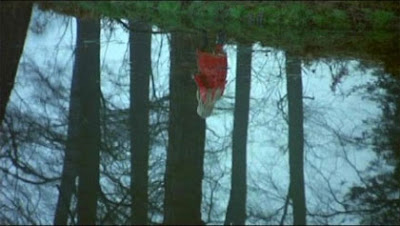
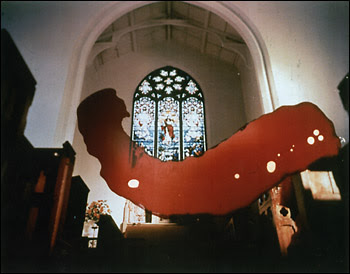
I actually watched this on Valentine's day, solidifying my penchant for the macabre on holidays with expectations of familial and/or romantic affection. However, this movie was totally appropriate. First of all, check out the visual theme of blood red! Secondly, the story is centered on the loving, albeit strained relationship of a married couple, John and Laura Baxter (Donald Sutherland and Julie Christie), following the death of their young daughter. This event takes place in the opening scene of the film. John has a sudden vision of the occurrence shortly following the ominous spill on the slide he is working with (see above). Throughout the rest of the film, we are revisited by images that recall the dead girl in his arms.

Following this calamitous event, the Baxters relocate to Venice, where John is restoring a church. Being constantly surrounded by water, much like the lake where their daughter met her demise, this is the perfect setting for the inevitable portentous reflection and imagery. Roeg also uses the setting to evoke a sense of isolation and even claustrophobia.

What really makes this film visually memorable is not only the many reflective shots and zooms, but the harshness of the parallel editing. Although it is often used to represent simultaneity of actions across a distance, the editing here sometimes has the effect of creating an overlay of present and future. The opening scene lays the groundwork for this editing style. As John and Laura lounge about in their living room, their daughter runs by the waterside. Though the daughter is an important character in the film, we never see her alive with either of her parents; she is, and will always be, separate. Probably the most famous montage in the film is the lengthy, graphic sex scene, which is inter-cut with images of the Baxters getting dressed afterward, in their separate spaces. I think this collapsing of time is interesting, since this is a movie where fate plays a big role. Time is out of sync, as if it doesn't matter. Of course these montages also highlight the separateness of the characters. Simultaneously, they are having incredibly separate experiences, each one alone.
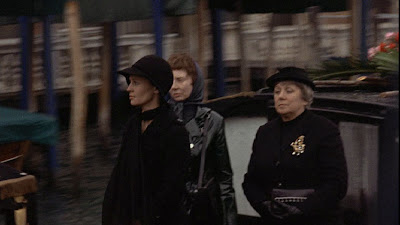
I am a sucker for supernatural elements in fiction and film, particularly if they are used well. In Don't Look Now, Laura stumbles upon a pair of sisters, one of whom has the gift of "seeing". She is blind, but she can interact with the dead. There are hints that John has this capability as well, though he is suppressing it. This undercurrent of clairvoyance creates an interesting circularity in the plot. The film begins and ends with deaths that are inexorably linked. By the end, I wondered whether the imagery throughout the film was recalling John's daughter's death or (ahem, SPOILERS) predicting his own. In its final moments, this movie gets extremely dark, and as I said, shocking.

Also, if you're interested, I found this funny montage of the film, which is set to a Moby song. The internet makes great things, doesn't it?

And because I just can't help myself... the final moments of the film, which means, the part when all is revealed. And also a good demonstration of the montage technique used throughout to heighten the fatalistic aspects. I hate the term SPOILERS, since this blog isn't really about reviewing; it's about analysis (however basic). But I guess it's only polite to use it here.


Wednesday, February 24, 2010

Boom Boom Boom

Git Sum Strange Love


This is the first video I've tried to embed. I think I will do it more often.

... Don't watch this if you are expecting to be surprised by the end of this movie.

Tuesday, February 23, 2010

Dr. Strangelove or: How I learned to Stop Worrying and Love the Bomb

I didn't have time to screen cap this, because I borrowed it from a friend who was very specific about the time that he wanted it returned. That was probably smart of him, though. I tend to collect other people's belongings and absorb them like the Blob. As a result, unfortunately, I'm making do with borrowed images, as well. I really like the process of making screen captures because it allows me to revisit the film I just watched, which allows me to engage with it again. I also like being able to choose my images rather than being forced to rely on what is available.

For instance, Google fed me variations on this image over and over, which is just fine, but not terribly interesting, except as a demonstration of how delightfully creepy Dr. Strangelove is. Those teeth make me shudder:


So anyway, failing to use my own images degrades the quality of my writing. That being said, this isn't my most dedicated work. End disclaimer.

Being a fan of Stanley Kubrick's and of black comedies in general, I had been meaning to see this film for a long time. I've always been drawn to the black comedy genre, since clearly the best way to make an already disturbing topic twice as disturbing is by turning it into a joke. It might be pointless to relay the narrative of this film, since it seems like pretty much everyone but me has already seen it. But what happens is that General Jack Ripper (Sterling Hayden) goes a little FUBAR and singlehandedly unleashes the U.S. air force on Russia. Highlighting this in the war room is a "big board" with an enormous map of Russia and images of missiles closing in on it from all directions. There is only one code to pull them off; Ripper is the only one who knows it. The catch is that, unbeknownst to the world, Russia has created a "doomsday machine," which will bring about the end of the world if a bomb is dropped there. The film is mainly spent watching the buffoonish president and his advisers' fruitless attempts at restoring order.

Jack Ripper gives a rather infamous speech about the male essence, and how fluoridated water is a conspiracy to rid men of said essence. Notice the phallic cigar dangling from his lips. It is this fear of impotency that leads to his psychotic break, which leads to the launching of some phallic missiles. It's also notable that there is only one woman in this entire film, and she is in a bikini for her entire screen time. This is a testosterone circus, although few displays of traditional masculinity are actually portrayed, particularly not by Sellers' characters (Lionel Mandrake, President Merkin Muffley, Dr. Strangelove). Presumably, Ripper tires of the incessant cowardice of the Cold War and just decides to make a move. Or maybe the Cold War was never about cowardice at all; it was simply "a dick measuring contest," as a good friend of mine might say.

This movie is hysterical, and the naming is ingenious. Most people should know how this plays out, since the final moments of this film are pretty infamous. For good reason. There is no fighting in the war room. Yee-hah.