Wednesday, April 21, 2010

Picnic at Hanging Rock


In the year 1900 in Australia, a group of girls from Appleyard College, which seems to be little more than a bourgeoisie finishing school, go on a picnic to Hanging Rock, a beautiful, and craggy geological formation on the edge of the bush. Several students and one of their teachers vanish without a trace. This story is rumored to be based on truth, but as far as I can tell, it is entirely fictional.

In the novel upon which Picnic at Hanging Rock is based, the author actually included an explanation of what happened to the girls who disappeared. When it was published, this piece was left out because the story is so much stronger without it. One of the prettiest of the differences between fiction and real life is that in the fictional realm, no explanation is necessary. Real life doesn't offer that kind of poetic power. If the girls had disappeared in real life, there would be an answer somewhere, and during sweeps season, the hard-working scientists on CSI would find it. In Peter Weir's adaptation of Picnic, there is no causal explanation, no physical evidence, only speculation that the girls did not belong in the world they found themselves in, and thus, ceased to exist.

Thursday, April 15, 2010

The Land That Time Forgot

I caught this cinematic gem on TCM today. To make a long story short, a group of people find an island upon which dinosaurs and primitive humans live together against a backdrop of volcanoes and oil pits. The finer points remain undeveloped, and the narrative concentrates more on lava and dinosaur wars than the explanation of why this all exists in the first place. Naturally, it is a better experience as a result.


When I say "undeveloped," I mean that there is relatively casual introduction of a theory that each living thing on this island goes through the entire stages of evolution in its lifetime. There is a quick shot of women squatting in a fountain, supposedly laying eggs, and then the situation devolves into volcanic eruption and neanderthal abduction. But who really cares about that stuff? Show me more dinosaur fights.

Sunday, April 11, 2010

A Serious Man

Or as I like to refer to it: A Srs Man. That's the title for the Internet generation. This is a fairly complicated film that can be summarized relatively succinctly as a movie about the search for meaning in an entropic universe. Kind of like honing in on an elusive television signal in a vast, empty sky.

Sunday, April 4, 2010

Wild at heart and weird on top

Love Me Tender

There's a long and boring story about how I saw this movie for the first time, and was really too young and inexperienced to comprehend it. I didn't quickly forget what I saw, but it was a few years before I really "got it" in any profound way. It was my first David Lynch movie. After I saw it the second time, it really clicked for me. In a big, big way. I credit this film almost entirely with my love of cinema. Well, that's kind of a big claim. But it was one of the earlier times when I was really moved by film making and style, as opposed to narrative content.

Saturday, April 3, 2010

Sunday, March 28, 2010

Alphaville, une étrange aventure de Lemmy Caution

screen-capture-7

I'm going to hurriedly scribble some thoughts on this one. It's been a few weeks since I saw this now, and I've got a backlog of films, most of which will not make it on here. Anyway. I don't remember how I discovered the existence of this movie, but as soon as I learned of this Godard-directed, pastichey sci-fi noir, I leaped upon it immediately, like a moth to the proverbial flame! In a traditional sense, it is very noirish indeed. Godard makes something out of almost nothing, by which I mean, the budget. Most of the scenes are indoors, and except for some flashing lights and machinery, Alphaville could be any city, anywhere. Much of it could have been filmed in someone's basement or high school hallways.

Tuesday, March 9, 2010

The White Ribbon

I'll make this one relatively brief, mostly because it's so hard to know where to begin. Watching Haneke's films I always feel like I'm being taunted by a being whose intelligence is far greater than my own. His films are incredibly open ended, leaving some viewers claiming that there are no answers, while some claim with positivity that they know just what he was aiming for (check out the imdb boards). To me, Haneke is brilliant. He's the only director I can think of who is a master of visually storytelling, yet manages to make a movie, purposefully eliminating what other filmmakers would consider key scenes, only to have the film turn out better for it. In the White Ribbon, there is a masterful play of show and tell. Haneke makes choices that might be completely wrong in the hands of someone less capable.

Haneke manages to straddle some elusive barrier between subtlety of message and overtness. I mean, it's a morality play shot in high contrast black and white; that's pretty blatant metaphor. Also, it deals with the oppressed children in a German rural township who will grow up to be the Nazi generation. Yet, there's a profound deepness to his work, and i think it somehow hearkens back to what he chooses to show and what he doesn't. He doesn't condescend to his audience by handing them the answers on a platter. His films reflect a world where there are no easy answers.

The movie depicts a period of time, about a year in length, in which a serious of increasingly violent crimes are committed. Almost every single one happens off screen; we only see some of the aftermath--a body, a boy crying. Rather than cutting within the scene, Haneke tends to position the camera, then having his subjects walk in and out of the frame. Once in a while he will pivot the camera to follow them, but the camera remains stationary. He uses this method in the powerful scene depicting the punishment of two of the priest's children. They enter a room at the end of the hall, closing the door behind them. The camera rests, statically, and gradually we hear the sounds of whipping issuing from behind it. It has been said of Haneke that he likes to test the modern audience and its desire to witness violence acts; therefore, he deprives them of that pleasure. Here, denying us access makes the punishment even more shaming. The rest of the missing scenes work in a different way, because we are able to imagine any number of people executing the crimes. And forcing the audience to use their imagination in this way, makes even us possible perpetrators.
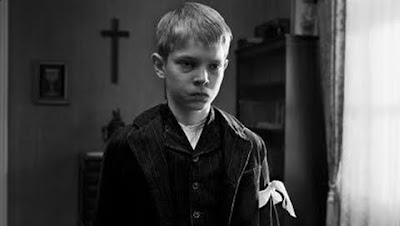
In another scene, the school teacher (Christian Friedel) witnesses one of these children, balancing tenuously on the railing of a bridge. The teacher anxiously yells for him to come down; the child claims, inscrutably, that he gave God a chance to punish him, but God didn't take the chance, so he must want him to live. Likening his parents, the highest authority he knows, to God, creates the oppressive state of ignominy leading to his and the other childrens' sociopathy. Throughout the film, we bear witness to the adults' hypocrisy. Their adulterous and incestuous crimes go unpunished, while the children are tied to their beds to prevent masturbation, or beaten for staying out too late (although what we are meant to assume they are doing might be deserving of such a punishment, or worse).

Did the children commit these crimes? Probably, yes. But Haneke, as he has done in the past, implicates everyone in these violent occurrences. Directly or indirectly, nearly everyone is responsible.

(image the first)
(image the second)
(image the third)